Read the Journal’s digital editions.
Or, select articles are available below in text form. For other articles, click the digital version link above, or check your mailbox for your issue of the Journal. To request copies of the print version, contact [email protected].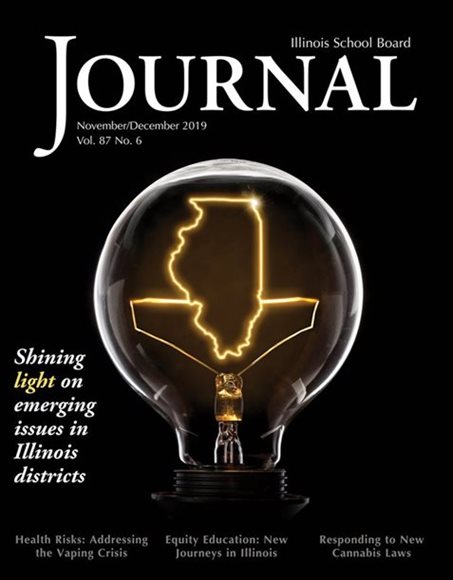
Cover Stories
-
Cannabis and new Illinois law: Assessing impacts to school districts
By Tony SandersThe CRTA has multiple legal and policy implications for Illinois school districts. Explore some of the implications as well as policy changes for school boards and school officials to contemplate in the areas of student discipline, employment policies and handbooks, public access to school facilities, and dual-credit programs. -
What Every School Leader Needs to Know About English Learners
By Sonia Soltero, Karen Garibay-Mulattieri, and Rebecca Vonderlack-NavarroThe term “English Learner” has been used since No Child Left Behind to describe students who need specialized instruction to master the academic English necessary for scholastic success. Illinois is currently referring to English Learners as “Emergent Bilinguals,” to focus on their potential to become fully multilingual. These students’ educational experiences and academic opportunities serve as a critical conduit for how they will flourish and succeed as adults. -
The Student Vaping Crisis: How Schools Are Fighting Back
By Denisa R. Superville and Arianna ProtheroThe surge in the number of students using e-cigarettes, the proliferation of products designed to disguise vaping, and the recent increase in serious vaping-related illness, is raising concern across the nation and in Illinois.
-
Q&A: Educational Equity
As answered by Bea Young Associates, LLC: Collaboration for Educational Equity and compiled by Theresa Kelly GegenEducational equity means that every student has access to the educational resources and rigor they need at the right moment in their education, and students’ needs are not going unmet due to race, ethnicity, dominant language, disability, gender, sexual orientation, religion, family background, and/or family income.
IASB's definition of equity speaks to fairness and inclusion. Fairness posits no personal and/or cultural attribute of an individual should interfere or distract from that student’s potential to succeed. A way to think about inclusion is that school districts actively examine their assumptions, policies, practices, personnel, and curriculum to remove systemic obstacles to student achievement.
Feature Articles
-
Innovative Approaches to Dealing with Student Demographic Shifts
By Francela LopezDiscover how one district developed an dexecuted a plan for addressing issues of equity, student achievement, and linguistic diversity.
Regular Features
-
Leadership Letter: What’s Next?
By Thomas E. Bertrand -
Policy Page: Work to Do: New PRESS Issue Outlines Legislation Requiring Board Action
By Kimberly Small and Ben Schwarm -
Practical PR: 10 Simple Tips for Telling Your District’s Story
By Natalie Symonds