Delivered via email: June 1, 2026
General Assembly Passes FY27 Budget and Other Key Bills
In the final days of session, with both chambers working well into the early hours of the morning on June 1, the General Assembly passed the FY27 budget, the Budget Implementation Plan (BIMP), a revenue package, and several other key legislative initiatives including a cannabis omnibus bill, a state bond authorization bill for capital projects, a downtown Springfield renovation bill, and the Children’s Online Social Media Safety Act which is an initiative of Governor Pritzker.
However, a legislative solution to help the Chicago Bears build a stadium in Illinois did not materialize prior to the end of session. Previous legislative conversations around the Bears stadium had been part of a larger conversation led by Governor Pritzker to provide a framework for statewide megaprojects and resulted in HB910 passing out of the House in March. Without the Senate votes to pass HB910, Senator Cunningham introduced the Municipal Stadium Authority Act (HB958), on the final day of session, which authorizes any home-rule municipality located in Cook County with a population of 70,000 to, by resolution, establish a municipal stadium authority for the purpose of financing and constructing a stadium. That bill did pass the Senate but was not called for a vote in the House prior to adjournment.
Other omnibus bills and high-profile legislative proposals that failed to pass before the General Assembly adjourned include several of the Governor’s BUILD IL initiatives, the Senate’s AI initiatives related to K-12 education, an Ethics/Elections omnibus bill, and an OMA/FOIA omnibus. Additionally, despite efforts to include HB4416, which allows Educational Support Personnel to collect unemployment insurance, into an omnibus bill, that did not occur.
Please join IASB for a comprehensive review of the spring session, End-of-Session Wrap-Up & Advocacy Ambassadors Meeting. This webinar will take place on Friday, June 5, from noon to 1 p.m. The Governmental Relations team will share insights and answer questions.
FY2027 State Budget (HB111)
Early Monday morning, the Illinois General Assembly passed a $55.9 billion budget bill (HB111) for fiscal year 2027 (FY27) which closely aligns with anticipated revenue. For K-12 education, the General Assembly’s final FY27 budget is similar to the Governor’s recommended FY27 budget with a couple of exceptions:
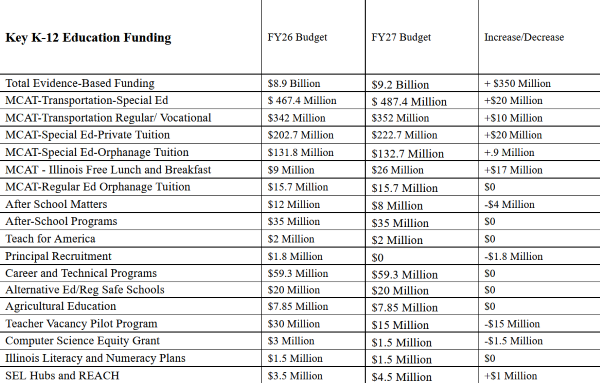
- The FY27 budget allocates the full $350 million in new funding to the Evidence-Based Funding formula (EBF), bringing total EBF funding to $9.2 billion. In doing so, it restores the Property Tax Relief Grant (PTRG). Last year, in the FY26 budget, the EBF allocation was only $307 million, falling $43 million short of the statutorily required $350 million annual increase which was achieved by cutting the PTRG. While the Governor proposed cutting the PTRG again in FY27, there was enough legislative interest in property tax relief to restore it in the FY27 budget. However, one important change to this program is that school districts receiving the PTRG will have to abate taxes for three consecutive years (currently the requirement is two years).
- Mandated Categoricals (MCATs) were increased beyond the Governor’s proposed FY27 recommendations by $17 million through an increase to the Free and Reduced Lunch line item. This brings the total FY27 increase in MCATs to almost $68 million over FY26 amounts. While this is still less than the amount needed to keep MCAT proration levels flat to FY26 levels for Special Education Transportation, Regular Ed Transportation and Special Education Private and Public Facilities, the commitment to increase MCATs is important in a tight state budget year.
K-12 Budget Summary
Budget Implementation Plan (HB2949)
Another significant piece of legislation that passed is the Budget Implementation Plan (BIMP), a companion bill to the budget which makes changes to statutes and policies to allow allocated funds to be spent. For K-12 education, some new programs and initiatives in the BIMP include:
Downstate Transportation
The Governor proposed two new downstate transportation initiatives that could benefit school districts.
- Downstate Reduced Fare Grant Program (DRF) - $20 Million was appropriated for this program. Under the program, the Illinois Department of Transportation may award grants to eligible applicants to support reduced fare programs for students enrolled in public schools or other career or technical education centers administered by ISBE.
- Downstate Cooperative Transportation Grant Program (DCT) - $15 Million was appropriated for this program. Under this program, the Illinois Department of Transportation may award grants to establish and fund cooperative transportation programs in partnership with public school districts, regional offices of education, public career centers, or other educational centers administered by ISBE.
ISBE Transportation Study
Given concerns over the substantial increases to transportation costs that school districts continue to experience, the BIMP requires ISBE to conduct a study on best funding practices for regular, vocational, and special education transportation. The study must also consider any potential impacts of incorporating transportation reimbursements into EBF.
FY27 Revenue Package (SB3019)
To help fund the FY27 budget, the legislature passed a FY27 revenue package to raise a number of revenue streams which are projected to bring in over $800 million in new funds. Some of the key revenue enhancements and anticipated revenue include:
- Social Media Platform Fee - $200 million
- Tax change lowering the cap on corporate net operating loss deductions - $300 million
- Tax on Digital Assets (cryptocurrency) and Fantasy Sports - $65 million
Key K-12 Legislation Passed in the Final Days
Several K-12 bills of interest passed both chambers in the last week of session. A comprehensive list will be sent to members in the coming months, but some highlights are included below.
- SB2427 (Castro/Mussman), Cell Phone Policy - An initiative of the Governor’s office that requires, beginning in the 2027-2028 school year, districts to develop and implement a policy which prohibits the use of cell phones and other wireless devices in K–12 classrooms during the school day. The policy may allow high schools students to use cell phones during lunch and passing periods. Additionally, districts may keep their current cell phone policies in place for up to five years if certain conditions are met.
- SB3070 (Preston/Davis), CTE Alternative to 2-Year Foreign Language Requirement – This bill creates an alternative to the two-year foreign language requirement for students by allowing them to instead take two years of career-focused coursework authorized by ISBE. Earlier in the week, another bill, HB4795 (Ammons/Lightford), that would have completely removed the two-year foreign language mandate, passed out of the Senate but stalled in the House. SB3070 did pass both chambers and offers one important exception to this curricular mandate. Importantly, there is a legislative commitment to continue working on a more comprehensive solution to this issue over the summer in the hopes of having a bill ready for veto session.
- HB3772 (Davis/Lightford) K-12 Student Discipline – An initiative of the State Board of Education that puts limits on the use of suspensions and expulsions for students in grades K-2. This bill was heavily negotiated last year but had stalled in the final days of session in 2025.
Upcoming Dates
June 5: End-of-Session Wrap-Up & Advocacy Ambassadors Meeting webinar from noon to 1 pm. Sign up here.
June 24: Resolutions or amendments to current Position Statements are due. Use the 2026 IASB Resolutions Form to submit your board's resolutions.
July 20: Early bird pricing ends for the COSSBA Federal Advocacy Conference in Washington, D.C. (September 21-23).