Delivered via email: October 23, 2026
Introducing 40 by 40: Fulfill the IDEA Promise
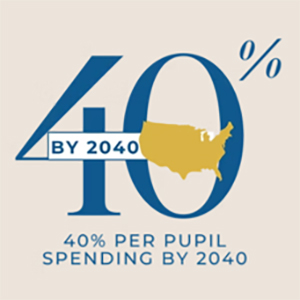 November marks 51 years since Congress enacted the Individuals with Disabilities Education Act (IDEA). This landmark law guaranteed every student with a disability a free appropriate public education. As Congress mandated local districts to provide these new services, it also promised to assist by funding 40% of the costs.
Local school districts have delivered on IDEA’s guarantee. In 2027, an estimated 8.3 million students will be served under IDEA, more than double the 3.7 million students served in the Act’s first year. However, year after year, Congress has failed to provide promised assistance. In 2027, Congress will provide just 10% of the costs to educate students under this Act. In Illinois, the federal shortfall is more than $1.4 billion annually, impacting every student because districts must cut other programs and services to cover the federal shortfall.
In the 40 by 40: Fulfill the IDEA Promise campaign, IASB and state school boards associations across the nation are joining together to fight this long-standing federal shortfall by demanding that Congress fulfill the IDEA 40% funding promise by 2040. The first step towards reaching this goal starts with our local school boards. We need every school board in Illinois to pass a resolution calling on Congress to commit to annual IDEA funding increases to reach 40% by 2040.
Will you join us? Learn more about the 40 by 40 campaign, use the resources to help educate your community about the importance of IDEA, and determine how your school board will take action.
FY 2027 Budget
Congress has funded FY 27 education programs through a Continuing Resolution, which expires on December 11. However, shortly before the end of FY 26 on September 30, the Administration sent Congress a list of $810 million in FY 26 rescissions, including a $25 million cut for Migrant Education. On September 29, the General Accounting Office (GAO) issued a decision that the President's rescission proposals are impermissible and do not allow the President to withhold appropriations beyond the end of fiscal year 2026. However, with Congress recessed until after the November elections, the recissions went into effect.
Although the House Appropriations Committee has put forward education appropriations legislation, the Senate has not yet taken action on a single FY 27 appropriations measure. When Congress returns in November, there will be a flurry of action on FY 27 spending, including potential language that would seek to prohibit future rescissions.
Administrative Updates
Education Tax Credit
On October 1, the Department of the Treasury released temporary and proposed rules implementing the education tax credit program established by the “One Big Beautiful Bill Act” in July of 2025. The bill established a tax credit of $1,700 for contributions to scholarship granting organizations that provide scholarships for education expenses for students in private and public schools. The new tax credit marks the first time federal revenue will subsidize private schools. The Department of the Treasury and the Internal Revenue Service expect that by the year 2030, the program will cost $26 billion annually. Thirty-one states have announced their intent to participate in the tax credit program. Illinois Governor JB Pritzker has said he was waiting for final regulations to be released and has not yet indicated whether Illinois will participate.
E-Rate
October 13 was the final day to submit comments on the request for feedback by the Federal Communications Commission (FCC) on whether the E-Rate program should be reduced, limited, or ended. According to an analysis by Funds for Learning, of the more than 2,500 comments that took a position on E-Rate, more than 98% advocated in favor of the program. Comments submitted by IASB and Illinois school districts are available in the FCC’s Online Database. You can still submit “Reply Comments” which respond to comments submitted. Reply comments close on November 12.
In a related development, the U.S. Court of Appeals for the 5th Circuit found that the FCC lacked authority to establish the Universal Service Administrative Company (USAC), which the FCC created to administer E-Rate. This ruling follows an earlier Supreme Court decision that held that the Congressional/FCC delegation of authority to the USAC was constitutional. The new ruling is likely to be challenged but portends additional uncertainty for E-Rate.
Department of Education's New Defend the Spend Requirement
At the end of September, the Department of Education issued a memo to all education grant recipients requiring grantees to provide a 255-character written justification for every drawdown of grant funds. The "Defend the Spend” requirement is the result of a February 2025 Executive Order. The new requirement begins on November 1, 2026, and impacts all grant programs, including those intended to be less burdensome for schools, such as the Small, Rural School Achievement grant. The Department released a step-by-step guide for grantees.
IASB Delegate Assembly Registration Reminder
The annual Delegate Assembly is the meeting where IASB members vote on proposals submitted by local school boards to direct the Association’s advocacy efforts. Each school board that is a member of the IASB is entitled to one voting delegate. The Delegate Assembly will take place Saturday, November 21, at 11:45 a.m. in the Grand Ballroom of the Hyatt East Tower. Only district roster managers can register your district’s delegate. Please register your delegate by November 8 to secure a lunch! Any delegate registered after November 8 can still participate but will not be guaranteed a lunch.