Delivered via email: September 25, 2026
COSSBA Federal Advocacy Conference
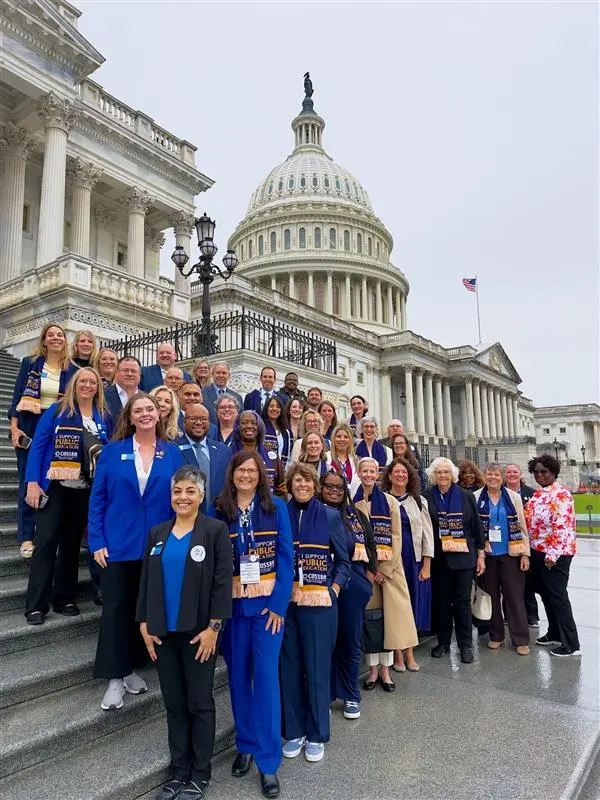 IASB hosted its largest-ever group of public school leaders at the 2026 COSSBA Federal Advocacy Conference, with 44 Illinois participants attending the conference held September 21-23, in Washington, D.C. During the conference, IASB members met with the offices of every Illinois Representative and Senator. School board members shared the data and stories of the students in their school districts to advocate that Congress support IASB’s key priorities on federal funding, including fulfilling the promise in the Individuals with Disabilities Education Act (IDEA), funding student achievement efforts, saving the E-Rate program, and bolstering teacher training.
At the conference, IASB and the school boards associations from Minnesota, Ohio, Iowa, and New York presented the upcoming 40 by 40: Fulfill the IDEA Promise campaign, during which school boards across the nation will pass resolutions in support of 40% funding for IDEA by the year 2040. To kick off the 40 by 40 campaign, our coalition of school boards has launched a website which contains information, data and important advocacy resources. Additional details will be shared on IASB’s efforts in this campaign soon.
If you missed this year’s Federal Advocacy Conference, join us next September 19-21 for the 2027 COSSBA Federal Advocacy Conference in Washington, D.C.
FY 2027 Budget
On September 1, the House of Representatives passed the Senate version of a Continuing Resolution (CR), funding the government in place of annual appropriations measures, until December 11, 2026. Though this provides temporary funding certainty, progress is still stalled on FY 27 education appropriations legislation. In June, the House Appropriations Committee adopted funding legislation that included a 10% cut to Title I funding for low-income students, the elimination of teacher training and English Language Acquisition programs, as well as significant reductions for education research funding and state assessments, which are key tools school boards use in their efforts to drive student achievement. Last year, bipartisan education funding legislation adopted by the Senate Appropriations Committee formed the basis for FY 26 funding; however, the Senate has not yet considered a single FY 27 appropriations measure.
Administrative Action
E-Rate
The Federal Communications Commission (FCC) continues to take comments until October 13 on its proposed rule that considers whether to eliminate or limit the E-Rate program. E-Rate, which funds affordable internet service and network equipment, provides $120 million annually for Illinois schools and libraries and is the fifth-largest federal funding source for K-12 public schools. Recent dialogue at the FCC has centered on concerns about screentime for students and questions about the value of educational technologies. However, E-Rate does not fund student devices, it only funds internet service, network equipment, and cybersecurity for those districts that are participating in the FCC's E-Rate cybersecurity pilot program.
Sharing similar views, the National Telecommunications and Information Administration (NTIA) hosted an E-Rate listening session on September 15. The two-hour session focused on student and parent concerns about screentime. Many participants suggested school district facilitation of parent opt-outs for digital technology should be a future condition of E-Rate funding.
Please see IASB’s E-Rate Call to Action to show your support for E-Rate. The FCC is accepting comments until October 13. Take the opportunity to tell the FCC how important E-Rate is to your school district, and what your district will have to cut to replace this funding should the FCC eliminate this key program.
Tax Credit for Educational Expenses
Regulations for the federal tax credit for donations to scholarship granting organizations (SGOs) who give scholarships to students for public and private school expenses are expected to be released by the end of September. The regulations are currently undergoing a final review at the Office of Management and Budget (OMB). Thirty-one states have announced their intent to participate in the scholarship program. Illinois Governor J.B. Pritzker has said he is waiting for final regulations before making a decision.
Office of Management and Budget (OMB)/Department of Education Rules on Federal Grants
In addition to funding the government through December 11, 2026, the CR passed by the House and Senate also delayed the implementation of a proposed OMB rule that would have given significant grantmaking power to political appointees at federal agencies. Bipartisan concern about the proposed rule contributed to its delay being included in the CR; the rule had been set to begin on October 1 but is paused until the expiration of the CR on December 11. A similar regulatory proposal by the Department of Education is also drawing criticism. COSSBA submitted comments on behalf of state school boards associations sharing concerns about the funding uncertainty these proposals would create.
School Nutrition Grants
The Departments of Health and Human Services (HHS) and Agriculture announced new grant programs to assist schools with nutrition expenses. The Harvest to Hallways Grant Program will provide $75 million in new grants to help schools access locally produced food as well as better equip school cafeterias. The HHS DEPEND program will provide $32.5 million to school districts to test innovative approaches to delivering nutritious foods to students and develop evidence about school nutrition interventions.
House of Representatives Action
House Passes Science of Reading Act
On September 16, the House of Representatives passed H.R. 7890, the Science of Reading Act of 2026. The bipartisan bill requires federal grants supporting literacy instruction to be aligned with evidence-based literacy instruction consistent with the science of reading, including components such as phonics, fluency, and vocabulary. The Senate Health, Education, Labor and Pensions (HELP) Committee passed similar legislation in August, but it has not yet been considered by the full Senate.
State of Illinois Updates
Illinois Ed-Flex Waiver
ISBE recently announced a new waiver program designed to help school districts align their use of Elementary and Secondary Education Act (ESEA) grants with local efforts to improve outcomes for all students. On May 13, the U.S. Department of Education approved Illinois’ Ed-Flex program application for school years 2026-2027 through 2030-2031. ISBE provided the resources below to assist school districts in utilizing this new flexibility. Questions or requests for support may be sent to [email protected].
- Ed-Flex Guidance
- Ed-Flex LEA Training Webinar (presentation slides)
- Ed-Flex LEA Training Webinar (video)
- FY 2027 Ed-Flex Waiver Request Template (download)
- FY 2028 Ed-Flex Waiver Request Template (download)