 Educating Ourselves about Childhood Arts Experiences & Why They Matter
By Sunil Iyengar
A report from the National Endowment for the Arts reaffirms what we have learned from many prior studies — namely, that arts education is closely linked to positive academic outcomes and social and emotional development.
The report was published in the wake of data from the National Center for Education Statistics (NCES), based on survey questions co-designed by researchers from the Arts Endowment and NCES in 2024. That survey provides estimates of how much arts education is currently being offered by public schools nationwide.
Taken together, the two resources speak volumes about the varying degrees of access to arts learning opportunities that America’s children enjoy, and the measurable benefits of arts education for children of different ages and backgrounds.
The Arts, Social Skills Development, and Academic Achievement
The Art Endowment research report, Snapshots of Arts Education in Childhood and Adolescence: Access and Outcomes, gauges the presence of arts education in young people’s lives. It examines three longitudinal datasets from NCES, looking at the period from early childhood (toddlerhood through kindergarten) to age groups slightly older (first through fifth grade), before vaulting ahead to students enrolled in high school.
By following these groups of children through time, the researchers derive conclusions not only about the availability of arts experiences to children in and out of school, but also their participation in arts learning, and how these experiences support healthy development and academic progress.
Here are some of the high-level findings:
- At-home arts engagement of toddlers, preschoolers, and kindergarteners was positively correlated with a variety of social-emotional attributes and cognitive outcomes.
- Participation in out-of-school arts activities was positively correlated with many social-emotional attributes and academic outcomes for children from kindergarten through fifth grade.
- Among high schoolers, arts participation was positively correlated with social-emotional attributes during ninth grade, while arts course completion was linked with greater academic achievement, high school graduation, and post-graduation outcomes.
Translation? Let’s start with early childhood. Researchers found that parents who consistently sang songs and read books to their infants were more likely to interact with them in ways that supported the development of social competence, secure attachment, and cognitive skills —compared with parents who did not engage in those arts activities.
Among toddlers, arts engagement was associated with stronger parent-child relationships. Preschool-age children who consistently participated in any arts activity had higher scores on academic assessments (reading, math, and language) than children not engaged in those activities. Moreover, kindergarteners who participated in arts activities at home were seen to exhibit positive, pro-social behavior.
From kindergarten through fifth grade, children’s participation in out-of-school arts activities (e.g., taking an arts class or lesson or attending a concert, play, or show) was associated with the following social-emotional attributes as reported by teachers: positive approaches to learning; greater interpersonal skills; and lower rates of exhibiting internalized or externalized problem behaviors.
At each grade level from kindergarten through fifth grade, taking arts classes outside school was positively linked to reading, math, and science scores. In-school arts participation, by contrast, was positively linked with math and science scores only among third- through fifth-graders and with reading scores only among fourth- and fifth-graders. Some of these relationships proved inconsistent, however, when researchers accounted for students’ demographic and family characteristics.
The results for high schoolers were even more impressive — especially academically. High school participation in extracurricular arts activities was generally associated with positive outcomes as recorded by math scores, high school GPAs, high school graduation, and college GPAs. As for coursework, the completion of fine arts credits was related to higher cumulative GPAs in all core content areas (i.e., English Language Arts, Math, Science, Social Studies) in high school.
Further, the number of fine arts credits completed was associated with a far higher likelihood of obtaining a high school diploma or equivalent, compared with students who did not complete arts credits. Among students who pursued higher education, there was a positive relationship between the number of arts credits taken in high school and first-year college GPAs.
The Arts Endowment publication, Snapshots of Arts Education in Childhood and Adolescence: Access and Outcomes, is based on analytical reports and tables produced for the agency by RMC Research Corp. The datasets under analysis covered the years 2001-2018.
In addition to discussing the arts’ benefits for student learning in general, the report quantifies levels of arts access and participation by children of different backgrounds. The findings show “the state of play” (pun intended) for childhood arts learning in the years before the COVID-19 pandemic.
State of Play for Arts Education: Presence in K-12 Schools
In 2025, NCES at the U.S. Department of Education released the first wave of results from the School Pulse Panel Survey. Arts Endowment researchers worked with NCES to design the survey’s question items about arts education.
The School Pulse Panel Survey is administered to a representative sample of more than 4,000 K-12 public schools in all 50 states, the District of Columbia, and the territories. Principals receive a 30-minute online questionnaire once a month. In November 2024, they reported on a range of school characteristics, including whether standalone classes in arts education are offered, in which subjects, by what types of instructors, and for how many hours per week.
The principals were also asked whether their schools required students to take an arts class, what types of arts learning opportunities they provide to students outside school hours, with what types of organizations they partner in offering such opportunities, and whether the principals are satisfied with various resources their schools use in supporting arts education.
The most illuminating aspect of the survey is how the data allow us to compare these responses across different types of schools, geographies, and student populations. For example, although 73% of public schools offering standalone art classes require students to take “at least one music, visual arts, media arts, dance, or drama/theater class,” that number is considerably higher in the Northeast region of the U.S. (82%) and lower in the Western states (63%).
Arts education is also far more likely to be mandatory in elementary school than in middle school. Roughly 79% of elementary schools that offer standalone classes also require their students to take at least one, while only 60% of middle schools offering arts classes have such a requirement.
Both the smallest schools (those with fewer than 300 students) and the largest schools (those with more than 1,000) offering standalone classes were among the least likely to impose arts education requirements; 68% of each group did so (versus 73% of all public schools). And, not surprisingly, schools in the highest-poverty areas had lower rates of imposing such requirements (with 70% doing so) than did schools in less poor areas (74%), assuming they offered standalone arts classes to begin with.
Discrepancies exist in school music and visual arts access in terms of local economic conditions (87% and 84% of schools located in low-poverty areas offer standalone classes in music and visual arts, respectively, compared with 72% and 73% of high-poverty area schools). You will also find that marching band, band, or choir practice outside the school day are far more prevalent in suburban and rural area schools — of which 52% and 44%, respectively, offer those activities — than in city schools (37%).
At the national level, reliable and consistent data on arts education access and enrollment have proved difficult to obtain. Solely from this perspective, the School Pulse Panel survey is an invaluable asset. Both studies considered in this post — the NCES survey and the Arts Endowment’s Snapshots report — can help arts educators, arts organizations, and state education departments to identify critical gaps in service and to strengthen public understanding about the arts’ relationships to factors such as school readiness and academic performance.
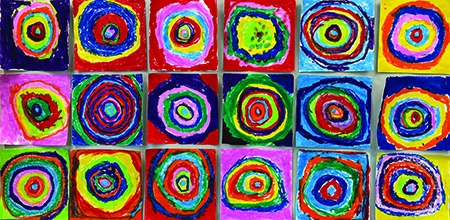
Sunil Iyengar directs the Office of Research & Analysis at the National Endowment for the Arts. Reprinted with permission of the Office of Public Affairs, National Endowment for the Arts, Washington D.C. Art: Collaborative project by Butler Elementary School students, Springfield SD 186. Image courtesy of Art Teacher Carrie Miles.