 Art & Opportunity
By Darrin Burnett
Like much of the art she teaches, Noelia Martinez-Voigt’s journey to becoming a teacher followed waves, curves, and zigzags instead of a straight line.
After graduating from Blackburn College in Carlinville with visual arts and communications degrees, Martinez-Voigt worked full-time for the college as an admissions counselor and part-time for an art-based company in Australia.
During the pandemic, she hosted and monitored YouTube arts education videos, assisting teachers and thinking about how she would teach the courses. That started her on a zigzagging path to teaching, and she landed in Greenfield CUSD 10, about 60 miles north of St. Louis, with just over 400 students across the district.
“My best friend works in Greenfield as an elementary teacher,” Martinez-Voigt said. “Their art teacher had quit, and she said, ‘You’d be great for it.’”
Her friend was right. Martinez-Voigt, Greenfield’s K-12 art teacher, was recently named the 2026 Illinois Outstanding Early Educator of the Year by the Illinois State Board of Education.
“It’s a fun roller coaster,” Martinez-Voigt said. “A chaotic roller coaster at times because I’m constantly switching between high school, middle school, and elementary school. Because of the way the schedule works, I’m jumping through different ages. It is extremely rewarding, and I’ve been able to create a space where students feel confident enough to try.”
Martinez-Voigt received a temporary certification to teach art, and, through the Golden Apple Accelerators Program, which assists college seniors and recent graduates as they transition to teaching careers, received her educator license.
She needed to add these steps to her path because of a recent law in Illinois. As of 2024, school districts, when hiring or assigning art, music, and physical education teachers, must prioritize those with certification and endorsement.
Greenfield CUSD 10 was fortunate when Martinez-Voigt’s path took her from Carlinville to Greenfield via virtual Australia and the world of YouTube. “If it wasn’t for her best friend, we wouldn’t be blessed with having her in the school district,” Superintendent Andy Stumpf said.
The district hasn’t been as lucky with its music program and has started the 2026-27 school year without a teacher, after three were offered the job and turned it down. Stumpf said he thought a retired teacher might be willing to return, but that did not work out.
Still, he hopes that Martinez-Voigt’s success can lead to greater recruitment in music, as well as the visual arts. “We can create a warm and welcoming environment,” he said. “We can’t pay them the most. We can’t flash money signs. We have to do our best to recruit.”
For small districts, finding qualified music and visual arts teachers at all, let alone naturally gifted ones like Martinez-Voigt, presents a sometimes-frustrating challenge. Stumpf watches his students do without a music program, or travel to nearby districts to take classes, and wonders if it would be better for the state to make it easier for smaller districts.
“Sometimes in the great state of Illinois, our hands are tied by laws created and passed by people who don’t work in education,” he said. “We’re trying to get lawmakers to understand.”
Advocates for arts education, always watchful in their fight for their discipline’s place in education, resist loosening requirements.
“I would argue that the students are hurt by that kind of decision-making,” said Michael Skura, Advocacy Advisor for the Illinois Art Education Association.
Skura, a past president of the Association, said the biggest challenge in his time with the organization has been the elementary school level. “The majority of the high schools understand they have to hire a certified art instructor,” he said. “The challenges are primary level music and art.”
Darcy Nendza, Executive Director of the Illinois Music Education Association, believes the pipeline to music education is “pretty robust,” although non-full-time jobs can be hard to fill.
Unlike visual or written arts, there is a common path for music education that can pull teachers out of the classroom: Private studio lessons. Nendza says those are not competing industries, pointing out that many school music teachers also teach privately.
Sometimes, the battle to keep the arts as a vital part of education means looking hard at other requirements. Beginning in 2028-29, incoming freshmen will be required, in order to graduate, to take two years of a world language or a Career and Technical Education alternative. Currently, languages are a one-year elective, the same as a fine arts course.
“That tipped the scales for world languages,” Skura said. “It will cause challenges in hiring practices and could create a major bottleneck for programs. Students will be trying to fit things into their schedule.”
Added Nendza: “Time is finite. We see it with world languages. We see it with a myriad of other things, all with good meaning and in good faith.”
Another award-winning teacher, Gillian Teichman of Lake Zurich High School in Lake Zurich CUSD 95, took the more traditional route to becoming an art teacher. Teichman won the Illinois Art Education Association Early Educator of the Year award in 2025.
“I had a clear idea when I was young. I wanted to be an art teacher,” said the 2022 Illinois State University graduate.
She credits her education degree with the strategies and theories she uses in her classroom. However, she can see a role for different paths for art teachers, in times of need.
“I see it as a double-edged sword,” Teichman said. “I dislike taking away the option altogether. I hope the district is supporting them and connecting them with conferences and other organizations.”
The pipeline from sitting in class to teaching the class works in coincidental ways sometimes.
Josh Shearer, an art teacher for grades 3-8 in Anna CCSD 37, replaced his own retiring art teacher when he started his career in the Pulaski County district. The teacher had encouraged him to consider art education. After four years, he moved on because the district cut the program.
Shearer has founded a non-profit called “Art for All” and focuses on districts and schools without art programs. “One of the first schools I worked with had been through five art teachers,” he said. “They move to where they make more money.”
Art teachers sometimes spot potential future teachers and do their best to encourage them. After all, with the requirements that fine arts teachers have proper certification, it can be a stable career field.
“A girl I taught in seventh and eighth grade now teaches in another district,” Shearer said. “I’ve got a student in Chess Club who wants to be an art teacher. I try.”
Teichman teaches high school and is careful about whom she recommends pursuing education. “Teaching is for a lot of people, but it is not for everyone,” she said. “Do you like working with kids?”
Going through the traditional arts education model provides skills that someone like Martinez-Voigt, who transitioned to teaching post-undergraduate, learned in a crash course.
Through the Golden Apple program, Martinez-Voigt went back to Blackburn College to learn classroom management, lesson planning, and teaching standards. She would teach on a temporary certificate by day and take classes and work on assignments in the evening. She had no second thoughts.
“I needed it and felt like I wanted to do it,” she said. “It’s doable.”
Martinez-Voigt and the other art teachers agree that pursuing a career in art education is not only “doable,” but vital.
National Endowment for the Arts studies show arts education helps close achievement gaps and increases the chances a student from a low-income school goes on to earn a bachelor’s degree, find a job, and become a community leader. Beyond that, art teachers speak about the basic human need for the arts.
“It makes us human,” Martinez-Voigt said. “What sets us apart from other living creatures, if not art? Just to tell our history, without art, how would we know what George Washington even looked like?”
Art is what survives, Skura says. “We’re not going to remember what trades or commerce took place 2,000 years ago, but we remember the murals, the sculptures, the writing, and the culture they contributed to.”
Beyond the emotional and spiritual impact, art teachers make sure their students know there are careers and passions beyond being a struggling studio artist or a teacher. And art is not a fluff elective, they say.
“My tests are some of the hardest ones they take,” Shearer said. “My art class is very much a class. I’m trying to get them ready for high school, not an art institute.”
But the beauty of art is that there can be many answers, or many paths to the same place.
“I’ve been working in public schools for 39 years,” Shearer said. “Most classes, especially in elementary and middle school, there is only one right answer. Art gives you a chance to develop creativity, for you to provide the right answer. Every kid needs that opportunity.”
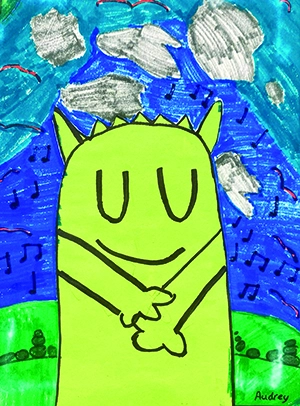
Darrin Burnett is Director of Policy Services with the Illinois Association of School Boards. Art: “Calm Color Monster” by Audrey B., student of Noelia Martinez-Voigt, Greenfield Elementary, Greenfield CUSD 10. Image courtesy of Noelia Martinez-Voigt.