 Administrator Salaries: Consistently Consistent
By Theresa Kelly Gegen
The only thing not consistent about this latest installment in the IASB Administrator Salary Series is the colors we are using to differentiate between superintendents, assistant and associate superintendents, principals, and other administrators.
The rest is business as usual.
Presented each year by the Illinois School Board Journal, the Administrator Salary Series takes a big-picture view, comparing full-time equivalent salaries plus monetary benefits for Illinois educators at the administrative level: District superintendents, assistant/associate superintendents, principals, and other administrators. Over time, overall and by subset, the percent change in salaries among Illinois education administrators mirrors the cost of living index, and has consistently done so since the coronavirus pandemic.
The data we use, the Educator Employment Information Public Data Sets, are, as the name indicates, publicly available. Salaries are as reported by the school districts to the Illinois State Board of Education, as required by the Illinois School Code (105 ILCS 5/10-20.47 and 5/34-18.38).
In each job title category, we compare 2024 to 2025 (the latest available numbers at press time) and also make regional comparisons. Typically, the regional breakdowns prove most useful to boards of education determining salary ranges for their administrators. Excepting the Northeast, each region includes one or more population centers, a mix of rural, suburban, and urban districts, and at least one state college or university, making comparisons reasonable and straightforward.
We also include superintendent salaries by district type (unit, elementary, high school) and by enrollment.
For this series, we remove salary data for Chicago Public Schools. With 320,000 students in 623 schools, it is by far the largest school district in the state and is among the top five in the nation. We also do not use data from Illinois Department of Justice programs or from independent charter schools. If a charter school is operated by a local public school district, its data is included.
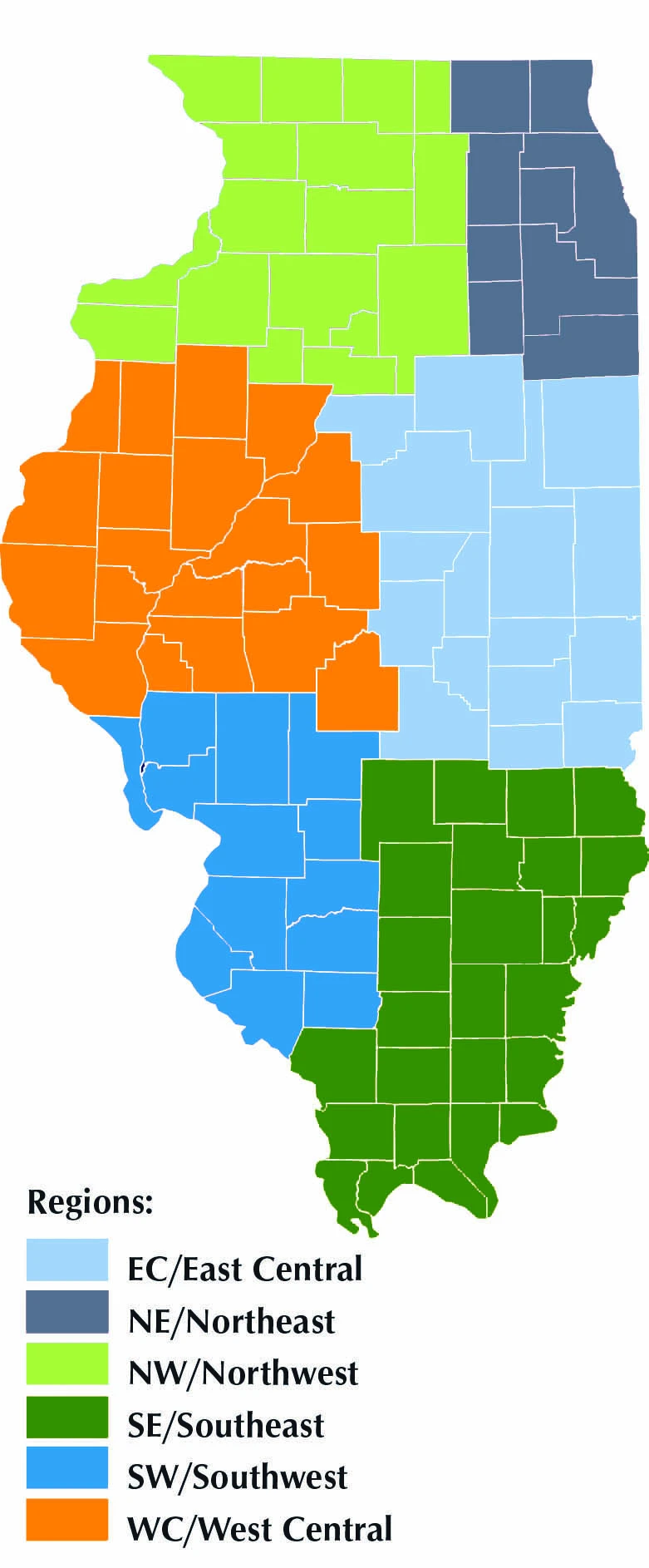
Even without Chicago Public Schools, the Northeast Region, which covers Cook, Lake, DuPage, McHenry, Kane, Kendall, Grundy, Will, and Kankakee counties, is determinative in almost every category. The regions in the Administrator Salaries Series are the same as when the studies began in 1991: Northwest, Northeast, West Central, East Central, Southwest, and Southeast (See Figure 1).
District Superintendents
Salaries for Illinois district superintendents rose a bit more in 2025 than in the previous two years. The average salary for a district superintendent rose from $211,132 in 2024 to $218,483 in 2025, an increase of 3.5% (see Table 1 in blue), compared to 2.9% from 2023 to 2024 and 2.8% from 2022 to 2023.
Regional differences still provide the key numbers for local school districts assessing superintendent salaries (see Figure 1 and Table 2A). The Northeast has the state’s highest superintendent salary and the highest average district superintendent salary at $282,146. As in years past, the Northeast’s average salary is the highest by a wide margin. The Northwest, at $198,124, is the next highest.
 Ranking the six regions by average district superintendent salary, from highest to lowest, starts with Northeast ($282,146) and Northwest ($198,124), as previously noted. West Central ($183,010) has overtaken East Central ($181,177) for third place, based on 2025 numbers, followed by Southwest ($174,335) and Southeast ($157,680).
Breaking the Northeast into county-based subsets, we see further evidence of regional impact (see Table 2B). In 2025, the average district superintendent salary in Lake and DuPage counties was $307,339, based on 90 superintendents. In Cook County, reporting 148 superintendents, the average is $289,717. And in the remainder of the region, comprising 90 superintendents in the far west and south suburbs (McHenry, Kane, Kendall, Grundy, Will, and Kankakee counties), the average is $244,501. In the rest of Illinois, we have 536 superintendents averaging $179,525.
Counting the entire state and sorting by district type (Unit, High School, and Elementary) shows expected results (see Table 2C). The average salary for a district superintendent is highest in the state’s 99 reporting high school districts, at $269,442, followed by the 371 elementary districts, averaging $226,882, and the 394 Unit districts, averaging $197,769. Because the cost of living in the Northeast is higher than that elsewhere in the state, it’s worth noting here that 346 of the state’s 394 reporting Unit districts lie outside the Northeast region.
For district enrollment, we break districts into five somewhat balanced categories after starting with districts with enrollments of over 3,500, the number that LUDA, the Large Unit District Association, uses to define “large.” (See Table 2D). We would expect that the higher the enrollment range, the higher the average superintendent salary. And the data bear that out in a near-perfect stair-step, from an average salary of $303,172 for superintendents in districts with enrollments over 3,500 to $154,104 for districts with enrollments under 400.
Associate and Assistant Superintendents
The average salary for assistant and associate superintendents rose by 3.6% from 2024 to 2025 (Table 1, yellow), a percentage change slightly larger than the previous two years.
These other categories further demonstrate the Northeast region’s dominance when crunching these numbers (see Table 3). There are 424 associate and assistant superintendents in the Northeast region, compared to 120 in the rest of the state combined. The associate and assistant high salary and average salary are the highest in the Northeast region. The average ranking, with Northeast ($222,159) as the highest and Southeast ($138,310) as the lowest, is the same for assistants and associates as it is for district superintendents.
Principals
The average salary gain for principals in Illinois in 2025 is 3.3%, a decrease from the previous year’s comparison (see Table 1 in green).
The regional rankings from high to low average salary depart a bit for principals (see Table 4). The top two remain Northeast at $170,059 and Northwest at $138,977, but Southwest at $128,233 jumps to the third-highest average principal salary. West Central ($126,101), East Central ($122,976), and Southeast ($115,017) follow. There are 1,612 principals in the Northeast region, more than in the rest of the state combined.
A similar analysis of assistant principals is also available.
Other Administrators
Our batch of “Other Administrators” includes Bilingual Administrator, CEO, CSBO, Dean of Students (w/Admin Endorsement), Director Area Vocational Center, General Administrator, Head of Gen Ed, and Special Education Director. Although their job descriptions differ, the salary data they provide is a good starting point for considering salaries for the many administrators who are not principals or superintendents.
Statewide, this “other” category saw a 3.1% salary increase from 2024 to 2025 (see Table 1, orange), which is lower than the 4.1% increase in the previous year. And, of course, the analysis slants towards the Northeast: 79% of the administrators in this category are in the Northeast (see Table 5). The average salary for these administrators in 2025 ranged from a low of $106,423 in the Southeast to a high of $158,202 in the Northeast.
About the Series
Since 1996, the Illinois School Board Journal, in collaboration with researchers in educational leadership, has published an annual report on the salaries of superintendents and principals in Illinois. Early data for the study were collected via a paper survey, resulting in a relatively low response rate.
Illinois school districts have been required by law since 2009 to report administrator and teacher salary information to the Illinois State Board of Education (ISBE). Data were briefly unavailable during the transition, and the Administrator Salaries series was paused for a few years.
With reporting standards in place and the data available to researchers, IASB’s study of administrator salaries was revived in 2014 and 2015. The series paused again in 2020 as the coronavirus pandemic suspended most normal operations and concluded the ability of the Journal’s longtime collaborators at Western Illinois University to participate. We are grateful for their work over the years to keep the series going.
Since 2022, IASB has presented the series in the Journal as analyzed internally. We adhere to the original standards for identifying trends, reportage, and analysis as faithfully as possible. We thank ISBE for its ongoing efforts to make this information available and the districts for providing the data, so the Journal can crunch the numbers and present an overview for boards of education to use as they make future salary decisions.
Conclusion
The Administrator Salary Series in the Illinois School Board Journal provides an overview. Districts seeking salary comparisons will likely want to disaggregate the data further to meet the expectations of their local communities. Districts are encouraged to do their own analyses of the data most relevant to them, using the same publicly available data from ISBE. If you have questions about how to do that, you can reach out to IASB at [email protected]. Also, the IASB Executive Searches team offers expertise that helps boards of education recruit and select a superintendent or other key administrator. Learn more about the Executive Search Process at IASB.com.
Theresa Kelly Gegen is the Editor of the Illinois School Board Journal. If you have questions about the Administrator Salaries series, contact [email protected] or visit IASB.com/administrator-salaries. Questions about the data itself can be directed to ISBE’s Department of Data Strategies and Analytics.